

Twilio Alternatives for Low-Volume SMS (Under ~5,000 Messages a Month)
Looking for a Twilio alternative for low-volume SMS? Compare Telnyx, Plivo and an own-SIM Android gateway on price per message, fees and 10DLC, with worked costs.

If your Twilio bill is dominated by fees rather than messages, you are probably looking at a Twilio alternative for low volume: a few hundred to a few thousand texts a month. This guide compares carrier-grade APIs (Telnyx, Plivo) with an own-SIM Android gateway, shows worked costs, and says plainly when each one is the wrong choice.
Why look for a Twilio alternative at low volume?
At small volume the per-message rate matters less than the fixed and hidden costs: number rental, carrier fees, US registration for 10DLC, and the effort of setup. Those can make a low-volume account cost more per message than its headline rate suggests.
The usual reasons people switch:
- Carrier fees on top of the base rate. Twilio's US page lists $0.0083 per segment plus carrier fees, for example $0.0035 (AT&T), $0.0045 (T-Mobile) and $0.005 (Verizon) outbound (Twilio US SMS pricing, as of October 2026).
- Registration and monthly fees. US business texting over local numbers needs A2P 10DLC registration, with one-time and monthly charges. Details in Do you need 10DLC?.
- Two-way from a real number. Many teams only want to text customers and read replies, not run a platform.
- Simplicity. Fewer products, one key, one endpoint.
What are the cheapest Twilio alternatives?
The cheapest hosted alternatives per US segment are Telnyx and Plivo, both below Twilio's base rate. Remember that carrier fees are similar across them, so the difference is the base rate plus number rental.
| Provider | US SMS base rate (per segment) | Number rental / month | Source |
|---|---|---|---|
| Twilio | about $0.0083 | about $1.15 local, $2.15 toll-free | twilio.com |
| Telnyx | about $0.004 local/10DLC, $0.0055 toll-free | about $1.00 (numbers generally) | telnyx.com |
| Plivo | about $0.0077 local, $0.0079 toll-free | about $0.50 local, $1.00 toll-free | plivo.com |
| Vonage | about $0.0086 (unverified, vendor page blocked) | about $1.05 (unverified) | vonage.com |
| SMSAPI.pl (international price list) | about €0.035 to the US, €0.036 to Poland, €0.040 to the UK per SMS, listed in euros, outbound only | no number needed for outbound; inbound/two-way not covered by this list | smsapi.com price list |
| Own SIM + Android gateway (smsportal) | no per-message fee | none (your mobile plan plus smsportal plan, see pricing) | n/a |
As of October 2026, approximate, before carrier fees (SMSAPI lists one rate per network and no separate carrier fee, so it is not directly comparable; confirm US registration requirements with them). Carrier fees add roughly $0.0035–$0.005 per US outbound segment (AT&T, T-Mobile, Verizon), with T-Mobile and Verizon values taken from the Twilio and Plivo pages. Vonage figures come from secondary sources because the vendor pricing page returned an error when we checked, so confirm before relying on them.
How much does each option cost at 300 to 10,000 texts a month?
At 1,000 outbound segments a month, Twilio costs about $12–$13 in messages, Telnyx about $8–$9 and Plivo about $11–$13, before number rental and registration. An own-SIM gateway adds no per-message fee. Here are the worked numbers.
| Outbound segments per month | Twilio (~$0.0083 + $0.0035–0.005 carrier) | Telnyx (~$0.004 + carrier) | Plivo (~$0.0077 + carrier) | Own SIM |
|---|---|---|---|---|
| 300 | $3.54–$3.99 | $2.25–$2.70 | $3.36–$3.81 | mobile plan + smsportal plan |
| 1,000 | $11.80–$13.30 | $7.50–$9.00 | $11.20–$12.70 | mobile plan + smsportal plan |
| 3,000 | $35.40–$39.90 | $22.50–$27.00 | $33.60–$38.10 | mobile plan + smsportal plan |
| 10,000 | $118–$133 | $75–$90 | $112–$127 | see limits below |
Our calculation from the vendor rates above, as of October 2026. Excludes number rental, 10DLC registration, inbound messages (usually billed too), and taxes. Multi-segment messages multiply the cost: a text over 160 GSM-7 characters is split into more segments, and accented or emoji text switches to UCS-2 with 70 characters per segment.
The takeaway: at low volume you are talking about a few dollars to about a hundred dollars a month. Switching providers rarely saves a fortune. It saves effort when the product fits the job.
What hidden costs should you compare besides the base rate?
Compare the whole invoice, not the headline number. Four items decide whether a cheaper rate really saves money at low volume.
- Segments. A text over 160 GSM-7 characters is split into parts of 153 characters. With UCS-2 (emoji or many accented letters) the limits are 70 and 67. A 120-character text with one emoji is two segments, not one, on every provider.
- Inbound messages. Twilio and Plivo bill inbound segments at roughly the base rate, so a flow where each text gets a reply costs about double. See How much does Twilio SMS really cost? for the numbers.
- Number rental. Roughly $0.50 to $1.15 a month for a local number and $1.00 to $2.15 for toll-free, as of October 2026.
- US registration. Local-number business texting needs A2P 10DLC (one-time brand and campaign vetting fees, then a campaign fee per month), and toll-free needs verification. Details are in Do you need 10DLC?.
A monthly view for 1,000 outbound texts with 20% replies, mid-range carrier fee, one local number and a low-volume 10DLC campaign:
| Provider | Messages (1,200 segments) | Number | Campaign monthly (~$1.50, Twilio's low-volume rate) | Approx. monthly total |
|---|---|---|---|---|
| Twilio | ~$15.40 | $1.15 | $1.50 | ~$18 |
| Telnyx | ~$10.20 | ~$1.00 | not on its pricing page | ~$11+ |
| Plivo | ~$14.50 | $0.50 | not stated | ~$15+ |
| SMSAPI.pl | ~€35 (1,000 outbound × €0.035; replies not covered) | n/a | check with SMSAPI | ~€35 |
| Own SIM | no per-message fee | none | none | mobile plan + smsportal plan |
Our calculation, as of October 2026, assuming a mid carrier fee of about $0.0045. Telnyx and Plivo 10DLC fees are not stated on their pricing pages, so ask before you commit. The own-SIM column excludes your mobile plan, which you likely pay anyway.
What does an own-SIM gateway cost and when does it fit?
An own-SIM gateway costs your mobile plan (many plans include unlimited texts) plus a smsportal plan, with a free plan to start. There is no per-message fee from smsportal. It fits two-way, transactional and conversational messaging at low to medium volume.
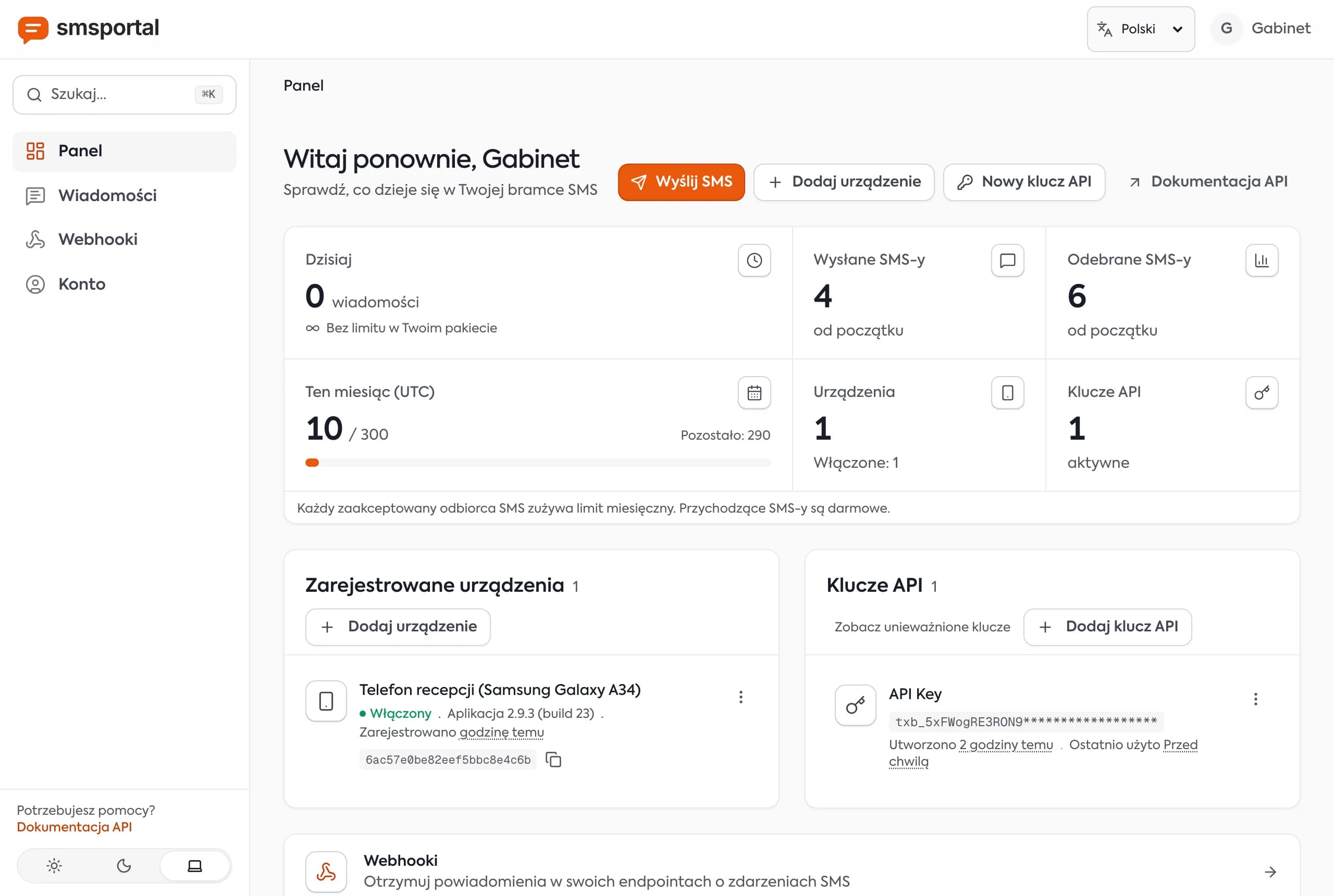
How it works, in short: install the Android app on a phone with your SIM, pair it with a QR code, create an API key, and send with a single request. Customers see your normal number and can reply, and replies reach the dashboard, the API and webhooks. See what an Android SMS gateway is for the full picture.
curl -X POST "https://smsportal.app/api/v1/gateway/send-sms" \
  -H "x-api-key: $SMSPORTAL_API_KEY" \
  -H "Content-Type: application/json" \
  -d '{"recipients": ["+14155550123"], "message": "Your car is ready for pickup until 6 PM."}'
Good fits:
- appointment reminders and confirmations with replies like "YES"
- order and delivery status to a few hundred customers
- internal alerts and monitoring
- an AI agent that texts a customer, through the MCP server
- a developer's side project that does not justify a Twilio account
What are the limits of switching to your own SIM?
An own SIM has real limits, and honesty about them is the point of this page. It is not a drop-in replacement for a carrier-grade API.
- No sender ID. Messages come from your number. Alphanumeric sender ID is not available.
- Throughput. The default send delay is 5 seconds, about 720 messages an hour per phone. Use several phones for more.
- Carrier rules. Mobile plans with unlimited texts usually assume person-to-person use, and carriers filter automated, bulk or unsolicited traffic. In the US, A2P traffic is regulated: see the 10DLC guide.
- Phone dependency. The phone needs power, signal and internet. Queued messages expire after 72 hours offline.
- No SLA and no iPhone as a gateway (Android 7.0 or newer).
The full list is in SMS gateway limits: when not to use one.
Warning: do not use a personal SIM for mass marketing. It can breach your operator's fair-use terms and get the number filtered or blocked. Use a registered, carrier-grade provider for campaigns.
So which should you pick?
Pick by job, not by price per segment alone. The simple rule: conversation and low volume point to your own SIM, campaigns and compliance point to a carrier-grade API.
| Your situation | Best pick |
|---|---|
| Under a few thousand transactional texts a month, replies from customers | Own-SIM gateway |
| Marketing campaigns to thousands of opted-in contacts | Telnyx, Plivo or Twilio with registered 10DLC |
| Need alphanumeric sender ID or international reach | Carrier-grade provider |
| Need SLA, short codes, many channels | Twilio |
| AI agent that sends and reads texts | Own-SIM gateway via MCP, or a provider API |
For the full cost model behind Twilio's invoice, read How much does Twilio SMS really cost?.
Try it before you decide
Create a free smsportal account, install the Android app, and send your first message in about ten minutes. Compare your real numbers with the table above. Plans are on the pricing section.
Prices are taken from the vendors' public pages as of October 2026 and change often. This is general information, not legal or financial advice.
Frequently asked questions
What is the cheapest alternative to Twilio for SMS?
Among carrier-grade APIs, Telnyx lists about $0.004 per US segment and Plivo about $0.0077, against Twilio's $0.0083 (as of October 2026). All of them add carrier fees on top. The cheapest option for low volume is your own SIM with an Android gateway, which has no per-message fee but is limited to conversational, low-volume use.
Is there a free alternative to Twilio?
There is no free carrier-grade SMS API at scale. An Android gateway using your own SIM and a free plan to start costs nothing per message beyond your mobile plan, if that plan includes texts. It only suits low-volume, consented, conversational messaging.
Do Twilio alternatives avoid 10DLC registration?
No. Telnyx, Plivo and other carrier-grade providers must follow the same US carrier rules, so business texts over a 10-digit US long code need A2P 10DLC registration. Toll-free numbers need a separate verification. See our 10DLC guide for fees and timelines.
Can I use my own phone number to replace Twilio?
Yes, for small-scale, two-way messaging. An Android phone with your SIM sends and receives through an API, and customers reply to your normal number. It does not provide alphanumeric sender ID, high throughput, or an SLA.
When should I stay on Twilio?
Stay if you need global coverage, many channels in one account, SLAs, short codes, or large campaigns. Twilio also has mature SDKs and compliance tooling. Below a few thousand messages a month the price gap is small in absolute dollars.